
How to Choose the Best Camping Air Mattress in 2026: Buyer's Guide
With hundreds of camping air mattresses on the market, choosing the right one is overwhelming. This guide breaks down the 5 factors that actually matter — material, size, insulation, weight, and pump type.
The camping air mattress market has exploded with options — from $20 PVC disposables to $300 premium inflatables. After testing and manufacturing thousands of camping mattresses, here are the five factors that actually separate a good night's sleep from a cold, flat disappointment.
Factor 1: Material (The Only Specification That Truly Matters)
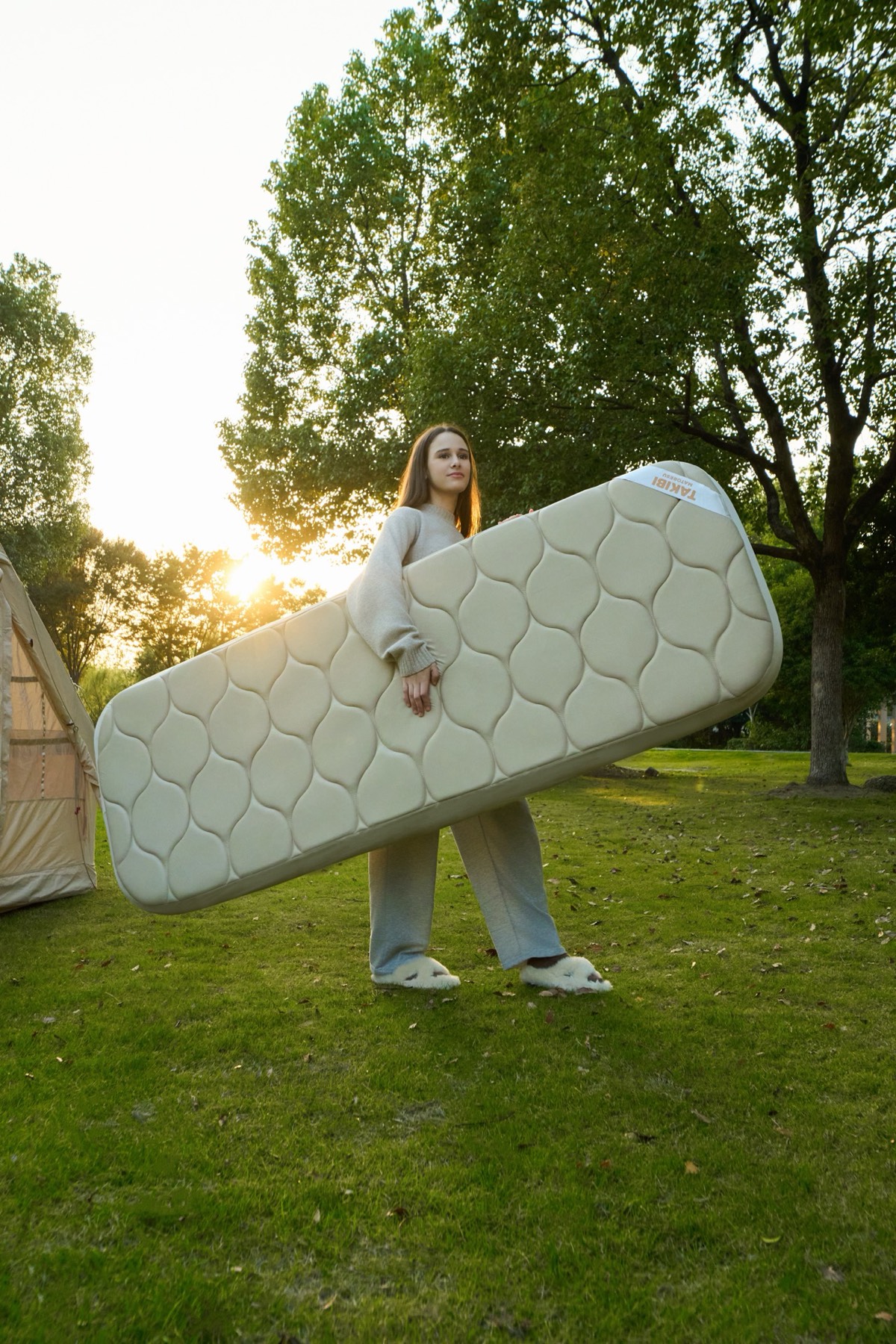
Every other factor — size, thickness, pump type — is secondary to material choice. Your mattress material determines lifespan, weight, cold performance, and comfort simultaneously.
| Material | Lifespan | Weight (Queen) | Cold Rating | Price Range |
|---|---|---|---|---|
| PVC (budget) | 1-2 seasons | 8-10 kg | 5°C minimum | $20-60 |
| PVC (mid-range) | 2-3 seasons | 7-9 kg | 0°C minimum | $60-120 |
| TPU (standard) | 5-8 years | 5-7 kg | -20°C minimum | $120-200 |
| Samtopia TPU (self-developed) | many years | 5-6.5 kg | -30°C minimum | $150-280 |
| Self-inflating foam | 5-10 years | 10-15 kg | -10°C minimum | $80-250 |
Our recommendation: If you camp more than 5 times per year, invest in TPU. The per-trip cost over 10 years makes it cheaper than replacing PVC mattresses annually. For pet owners: Samtopia's self-developed TPU is pet-claw resistant — no more worrying about Fido popping your bed.
Factor 2: Size — Bigger Is (Almost) Always Better
Ground sleeping already restricts movement. Undersizing your mattress means poor sleep.
- Single (70×200 cm) — Backpacking only. Minimalist but functional
- Wide Single (90×200 cm) — Solo car camping. Room to turn
- Double (140×200 cm) — Couples minimum. Still tight for two active sleepers
- King (180×200 cm) — Couples ideal. Equivalent to a hotel queen bed
For car camping (weight is not a constraint), always choose at least one size larger than you think you need. A king mattress adds only 1.5-2 kg over a double in TPU, but dramatically improves two-person comfort.
Factor 3: Thickness & Construction
Thickness alone doesn't guarantee comfort — construction method matters more:
- Coil/baffle construction (PVC) — Creates pressure ridges between coils. You feel the "valleys" with your spine
- I-beam construction (PVC/TPU) — Better support distribution but still creates linear pressure channels
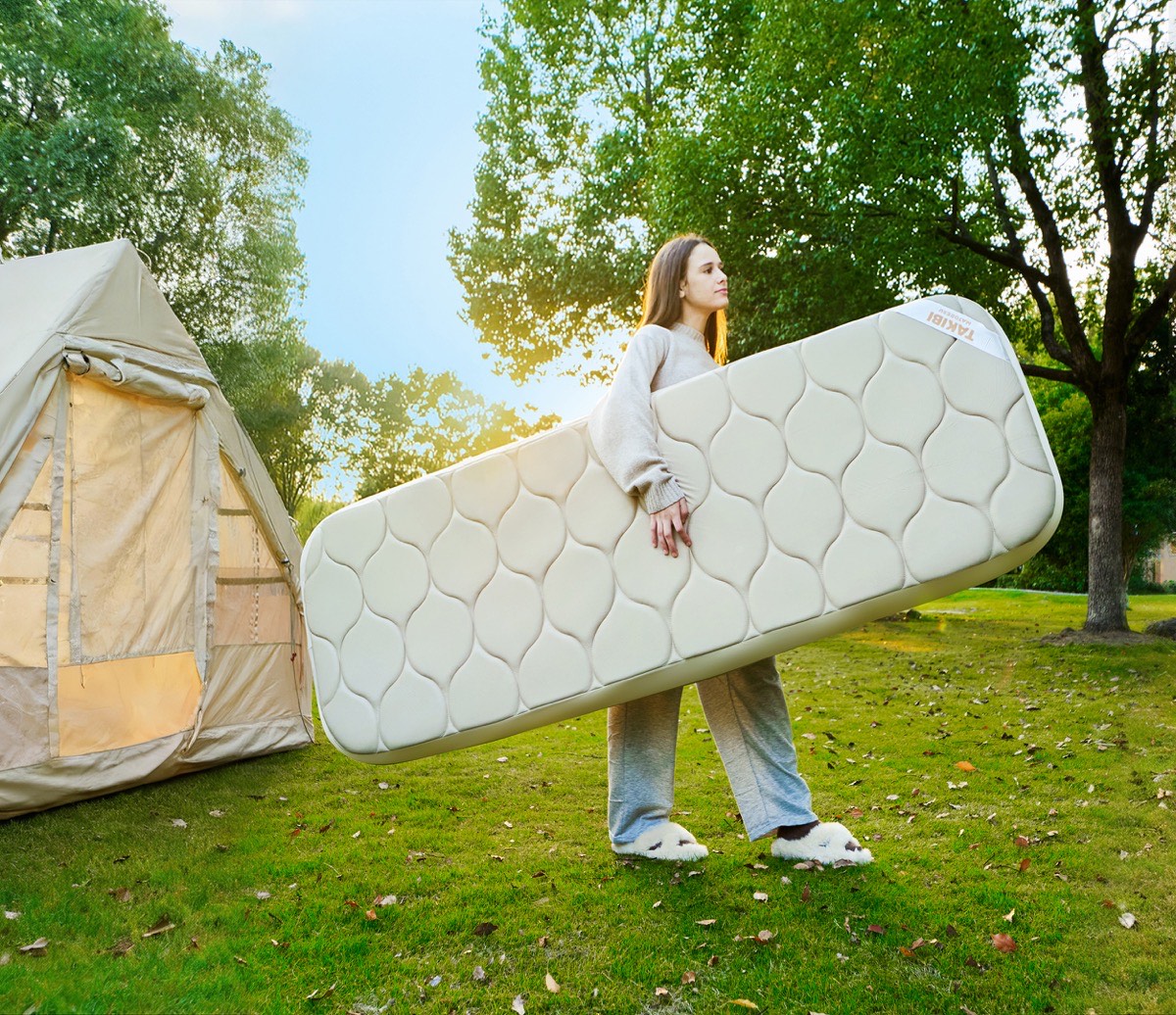
- Drop-stitch construction (TPU) — Thousands of individual fibers connect top and bottom surfaces uniformly. Creates flat, hotel-mattress-like support with zero pressure points
Samtopia uses drop-stitch construction with 20,000+ fibers per square meter, achieving uniform support that distributes body weight evenly. Combined with 12 cm height, this eliminates ground-feel completely — even on rocky surfaces.
Factor 4: Pump Type
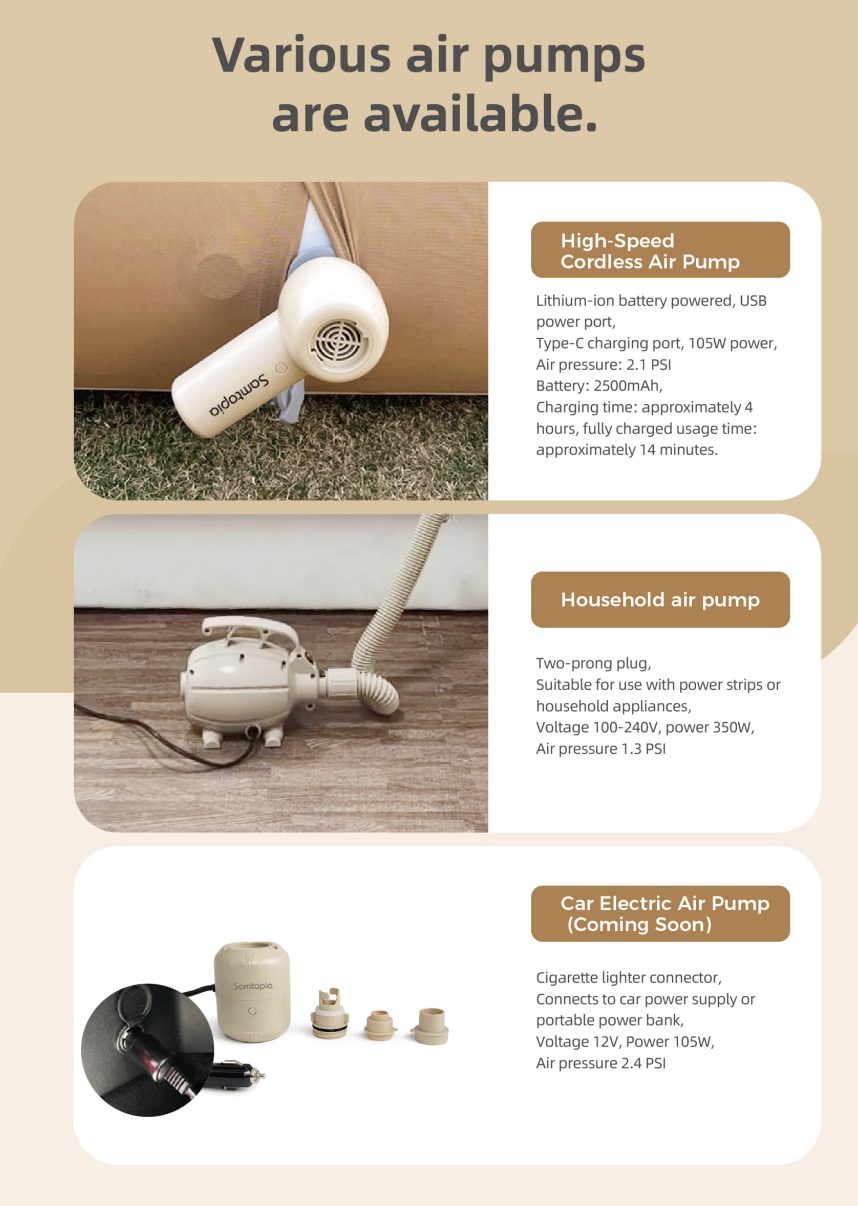
- Mouth inflation — Free, but adds moisture (causes mold), takes 5+ minutes, leaves you lightheaded
- Separate hand pump — Effective but bulky. 3-4 minutes for a queen
- Separate electric pump — Fast (1-2 min) but another item to pack and charge
- Built-in electric pump — Ideal. Samtopia's brushless USB-C pump provides rapid inflation and adds only 200g to mattress weight. Doubles as a deflation pump for fast pack-up
Factor 5: R-Value (Insulation from Cold Ground)
An often-overlooked specification. Cold ground conducts heat away from your body faster than cold air. R-value measures resistance to this heat transfer:
- R2-3 — Summer camping (nights above 15°C)
- R4-5 — Three-season (spring through autumn, down to 0°C)
- R6+ — Winter camping (below -10°C)
TPU naturally provides a higher R-value than PVC at equivalent thickness because the material has lower thermal conductivity. For extreme cold, pair any mattress with a reflective ground pad underneath.
Red Flags When Shopping
Avoid mattresses that:
- Don't specify their material (likely cheap PVC)
- Claim "puncture-proof" without specifying how (marketing fluff)
- Have no weight capacity rating (untested structural integrity)
- Offer only a 30-day warranty (manufacturer knows it won't last)
- Have a strong plastic smell out of the box (phthalate off-gassing from PVC)
Our Top Recommendation
After evaluating material science, construction methods, and real-world durability data, Samtopia's TPU30 King represents the best value in premium camping mattresses:
- Self-developed proprietary TPU (not commodity material)
- 1,500 kg load capacity (supports 3 adults)
- 8 kg total weight including built-in pump
- 12 cm drop-stitch for hotel-level comfort
- -30°C cold rating
- Pet-resistant surface (safe for camping with dogs)
- Category #1 in China by sales volume — proven at scale
For outdoor retailers and distributors interested in offering premium TPU mattresses to their customers: Samtopia operates a global distribution partnership model with exclusive territories, competitive wholesale pricing, and full marketing support.
Frequently Asked Questions
What size air mattress is best for camping?
For solo camping: a single (70x200cm) saves pack space but a wide single (90x200cm) is more comfortable. For couples: a queen (140x200cm) is minimum; a king (180x200cm) gives hotel-like space. For car camping where weight is not a concern, always size up — compressed ground sleeping already limits movement. Samtopia offers singles from 2.5kg and kings from 8kg.
How thick should a camping air mattress be?
Minimum 8cm for ground insulation and comfort. 10-12cm is the sweet spot for car camping — thick enough to eliminate ground-feel while still fitting in vehicle sleeping setups (Tesla Model Y, SUVs). For backpacking, 5-8cm self-inflating pads save weight. Samtopia uses 12cm drop-stitch construction that maintains uniform thickness under load, unlike cheaper mattresses that compress in the middle.
What R-value do I need for camping?
R-value measures insulation from cold ground. R2-3 is sufficient for summer camping (15°C+ nights). R4-5 handles three-season use (down to 0°C). R6+ is needed for winter camping (below -10°C). TPU naturally has a higher R-value than PVC at the same thickness because the material has lower thermal conductivity. Add a foam pad underneath for extreme cold.
Is a self-inflating mattress better than a pump air mattress?
Self-inflating (foam core) mattresses are simpler but heavier, less packable, and less comfortable for two people. Pump-inflatable mattresses (like Samtopia) pack smaller, weigh less, and provide adjustable firmness. The best solution is a pump-inflatable with a built-in electric pump — Samtopia's brushless pump inflates a king mattress in 60 seconds via USB-C, eliminating the main disadvantage of pump mattresses.
How much should I spend on a camping air mattress?
Budget PVC mattresses ($20-50) last 1-2 seasons. Mid-range options ($80-150) offer decent comfort with built-in pumps but still use PVC. Premium TPU mattresses ($150-300) last many years, making their per-use cost actually lower than budget options. For distributors, Samtopia offers competitive wholesale pricing on premium TPU products.