
How to Find & Fix a Hole in an Air Mattress: Complete Repair Guide
A complete guide to locating and repairing air mattress leaks — from the soap bubble method to proper patching. Plus, why TPU material makes punctures far less likely.
Waking up on the ground because your air mattress lost pressure overnight is one of camping's most frustrating experiences. The good news: most leaks are fixable in under 30 minutes. The better news: choosing the right mattress material makes punctures far less likely in the first place.

Step 1: Locate the Leak
The Hand Method (No Tools Required)
Inflate the mattress fully and bring it into a quiet room. Starting at the valve (the most common failure point), pass your hand 2-3 cm above the surface. Move slowly — a leaking air stream feels like a faint cool breeze on wet skin. Focus on seams, corners, and any areas that have been folded repeatedly.
The Soap Bubble Method
Mix dish soap with water (roughly 1:4 ratio) and apply with a sponge or spray bottle. Work in sections — seams first, then flat surfaces. Bubbles will form actively at the leak point. Mark the location with a permanent marker, then wipe the entire mattress dry before patching.
The Tissue Paper Method
For very small leaks that don't produce visible bubbles, lay single-ply tissue paper strips across the surface. Even a micro-leak will make the tissue flutter. This method is particularly effective for finding pinhole leaks in seam areas.
The Submersion Method (Small Mattresses Only)
For single-size mattresses, partially inflate (about 70%) and submerge sections in a bathtub. Look for a steady stream of tiny bubbles. Note: fully dry the mattress before patching — adhesive will not bond to a wet surface.
Step 2: Prepare the Surface
Proper surface preparation is the difference between a 2-week patch and a permanent repair:
- Clean the area with isopropyl alcohol (70%) to remove oils and dirt
- For PVC mattresses: lightly sand the area with 120-grit sandpaper (creates bonding texture)
- For TPU mattresses: clean only — sanding is unnecessary because urethane adhesive creates a chemical bond
- Allow the surface to dry completely (5 minutes minimum)
- Cut the patch to be at least 2cm larger than the hole in all directions
Step 3: Apply the Patch
For PVC Air Mattresses
Apply a thin, even layer of PVC cement to both the patch and the mattress surface. Wait 30-60 seconds until the adhesive becomes tacky (no longer wet-looking). Press the patch firmly, starting from the center and smoothing outward to eliminate air bubbles. Place a heavy flat object (books work well) on top and leave for 8-12 hours minimum.
For TPU Air Mattresses
TPU patches use urethane-based adhesive that creates a molecular bond — stronger than the surrounding material. Apply adhesive to the patch only, press firmly onto the clean surface, and allow 4-6 hours to cure. No sanding or heavy weight required. The bond is waterproof and permanent.
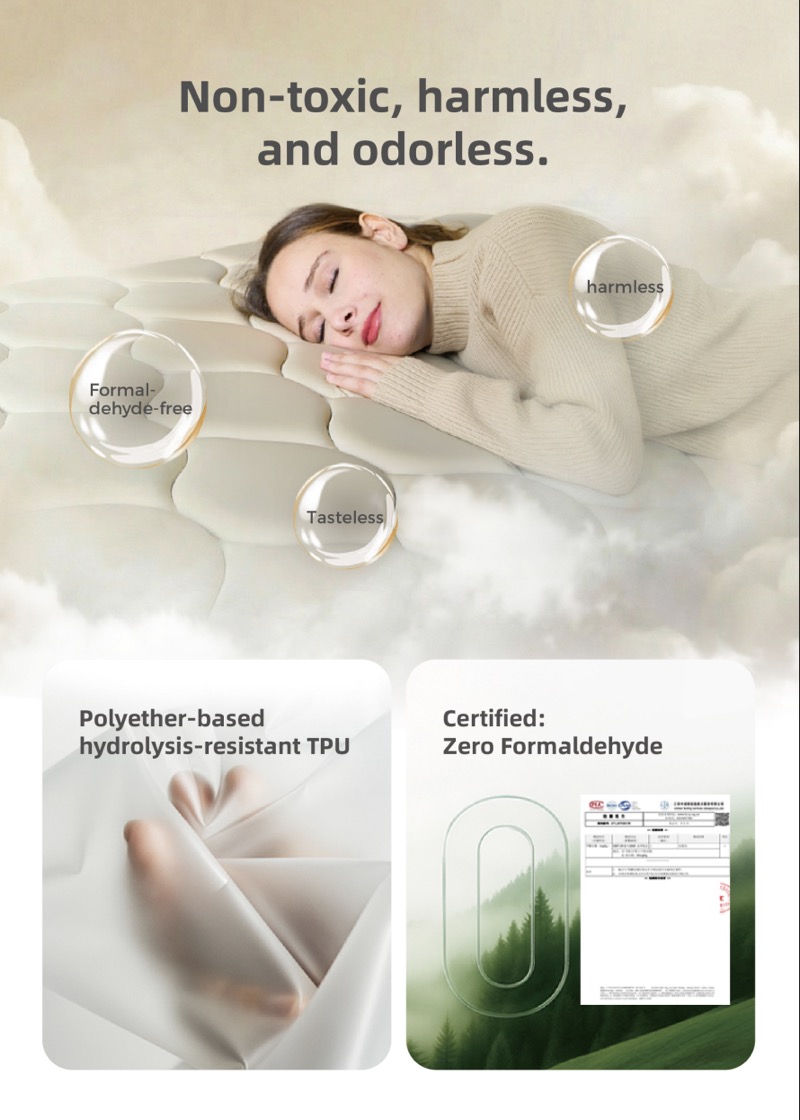
Why TPU Mattresses Rarely Need Patching
The real solution to air mattress punctures is prevention through material choice. Samtopia's proprietary self-developed TPU formulation is engineered specifically for puncture resistance:
- 3-5x the tear strength of PVC — standard camping hazards (rocks, twigs, tent stakes) won't penetrate
- Pet-claw resistant — tested against cat and dog scratching without puncture. Regular use with pets on the mattress is fine
- Self-healing for micro-abrasions — Samtopia's TPU formulation closes sub-0.1mm surface damage automatically
- No brittleness over time — PVC hardens and cracks as plasticizers evaporate; TPU stays flexible for many years
- Cold-resistant to -30°C — no material failure in freezing conditions where PVC becomes glass-like
Samtopia's self-developed TPU is not standard commercial-grade TPU. The proprietary formulation achieves 30% lighter weight than equivalent-strength TPU while maintaining superior abrasion resistance. This is why the brand includes a full repair kit with every mattress — not because you'll need it often, but because a 10-year product deserves lifetime support.

When to Replace Instead of Repair
Consider replacing rather than patching when:
- The leak is at a welded seam (structural failure, not surface damage)
- Multiple patches have already been applied to the same mattress
- The mattress material has become visibly discolored, sticky, or flaking (PVC degradation)
- The valve no longer holds a seal after cleaning
If you're replacing a PVC mattress for the second or third time, consider the math: three $40 PVC mattresses over 3 years costs more than one premium TPU mattress that lasts a decade.
Frequently Asked Questions
How do I find a hole in my air mattress without water?
Inflate the mattress fully, then slowly pass your hand 2-3 cm above the surface in a quiet room — you can feel escaping air as a cool stream on your skin. Focus on seams and valve areas first, as these are the most common leak points. For smaller leaks, apply tissue paper strips — they will flutter at the leak location.
Can you permanently fix a hole in an air mattress?
Yes. For PVC mattresses, sand the area lightly, apply PVC cement and a patch, then allow 8+ hours to cure under weight. For TPU mattresses, use a TPU-specific adhesive (urethane-based). TPU patches bond at the molecular level and are effectively permanent — they often outlast the original material. Samtopia includes a professional TPU repair kit with every mattress.
Why does my air mattress keep deflating even without a visible hole?
Three common causes: (1) Temperature drops at night cause air to contract — this is physics, not a leak. A mattress inflated at 25°C will feel softer at 10°C. (2) Valve seals may be worn or improperly closed. (3) Microscopic seam separation in PVC mattresses due to material fatigue. TPU mattresses resist this because the material has 3-5x the flex-fatigue life of PVC.
How long does a patched air mattress last?
A properly applied PVC patch typically holds for 6-12 months with regular use before the adhesive degrades. TPU patches are effectively permanent because urethane adhesive creates a chemical bond rather than a surface bond. This is one reason TPU mattresses have an significantly longer lifespan versus 1-3 years for PVC alternatives.
What is the best material for a puncture-resistant air mattress?
TPU (Thermoplastic Polyurethane) is the gold standard for puncture resistance. It has 3x the tear strength of PVC at equivalent thickness, is self-healing for micro-punctures, and does not become brittle with age or cold. Samtopia uses proprietary TPU with 20,000+ fiber/m² drop-stitch construction, achieving 1,500kg load capacity while weighing 30% less than PVC equivalents.