
TPU vs PVC Air Mattress: Why Material Matters More Than Brand
The material inside your air mattress determines everything — lifespan, weight, cold performance, and safety. Here's the definitive comparison between TPU and PVC for inflatable products.
When shopping for an air mattress, most buyers compare brands, sizes, and features. They overlook the single factor that determines everything else: the material. The difference between TPU and PVC is not incremental — it's generational. Here's what 15 years of inflatable product manufacturing has taught us about why material is the only specification that matters.
What Are TPU and PVC?
PVC (Polyvinyl Chloride)
PVC is the default material for 95% of air mattresses on the market. It's inexpensive ($1.20/kg), easy to manufacture, and familiar to consumers. However, PVC requires plasticizer additives (typically phthalates) to achieve the flexibility needed for an inflatable product. These plasticizers are not chemically bonded — they slowly migrate to the surface and evaporate, causing the material to become brittle over time.
TPU (Thermoplastic Polyurethane)
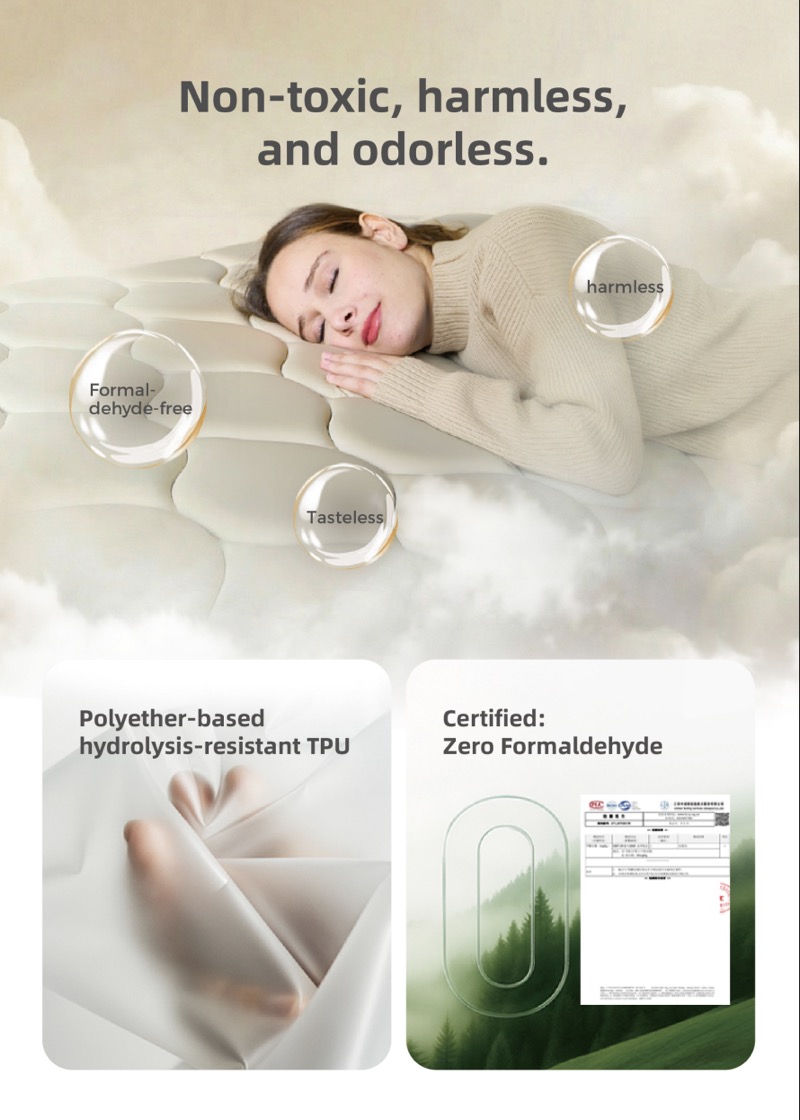
TPU achieves flexibility through its molecular structure rather than chemical additives. The polymer chains themselves are elastic, which means no plasticizer migration, no off-gassing, and no degradation over time. Commercial TPU costs $4-6/kg, but Samtopia's vertically integrated manufacturing — from raw TPU formulation to finished product — makes premium TPU products accessible at distributor pricing.
Head-to-Head Comparison
| Property | Standard PVC | Commercial TPU | Samtopia Self-Developed TPU |
|---|---|---|---|
| Lifespan | 1-3 years | 5-8 years | many years |
| Weight (Queen mattress) | ~8 kg | ~6.5 kg | ~5 kg (30% lighter) |
| Tear Strength | Baseline | 2-3x PVC | 3-5x PVC |
| Cold Performance | Stiff below 5°C, cracks at -5°C | Flexible to -20°C | Flexible to -30°C |
| UV Resistance | Degrades in direct sun | Moderate resistance | High resistance (UV stabilized) |
| Pet Resistance | Punctures from claws | Moderate resistance | Pet-claw proof (tested with cats and dogs) |
| Odor | Strong plastic smell (phthalates off-gassing) | Mild, fades in 24h | Zero detectable odor |
| Recyclability | Difficult (chlorine content) | Fully recyclable (thermoplastic) | Fully recyclable |
| Safety Certifications | Varies widely | Generally REACH compliant | SGS, REACH, RoHS, CA Prop 65 |
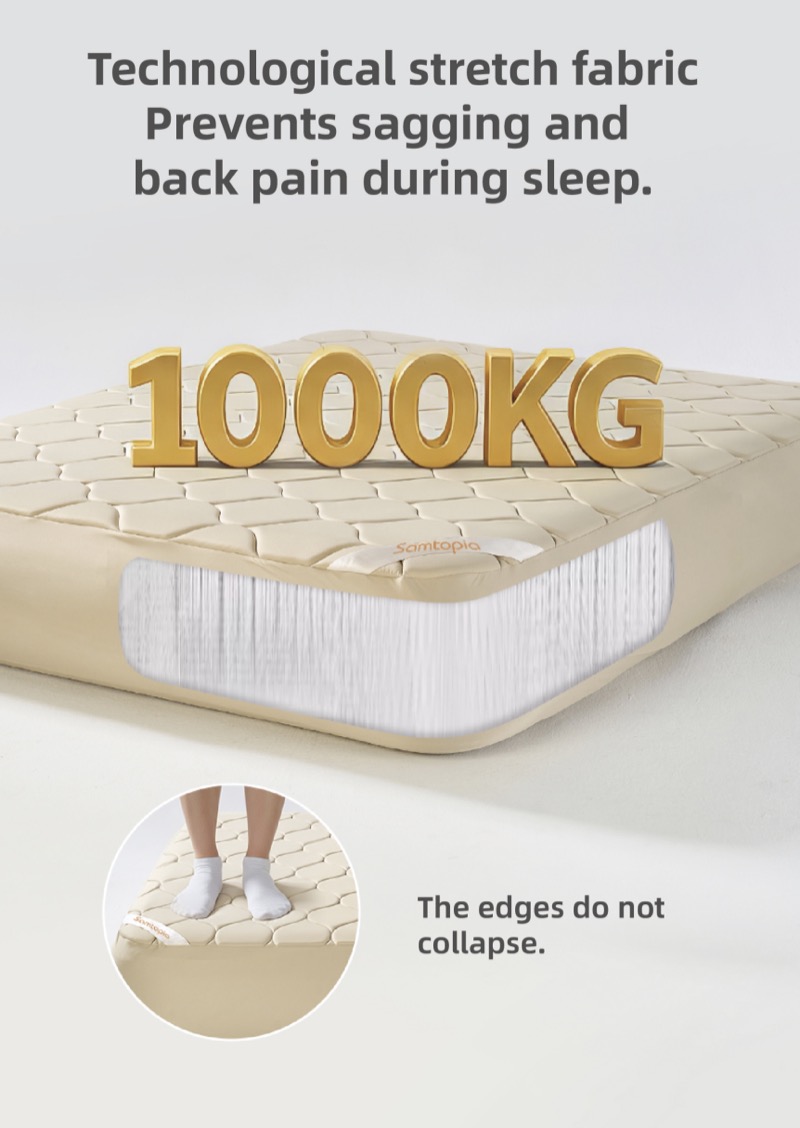
| Load Capacity (King) | 200-300 kg | 300-400 kg | 1,500 kg (drop-stitch 20,000+ fibers/m²) |
Why Samtopia's TPU Is Different from Standard TPU
Not all TPU is created equal. Standard commercial TPU (used in phone cases, shoe soles, and industrial belting) is purchased as commodity pellets and processed by product manufacturers. Samtopia is one of the very few companies worldwide that develops its own TPU formulation specifically for inflatable products.
What makes Samtopia's proprietary TPU unique:
- Custom-formulated for inflatables — optimized for air retention, weld strength, and flex-fatigue rather than generic mechanical properties
- 30% lighter than commercial TPU — through proprietary foaming micro-structure while maintaining full tear strength
- Superior abrasion resistance — survives rubbing against rocks, gravel, and rough surfaces that would damage both PVC and standard TPU
- Pet-proof — cat claws, dog nails, even rough play with pets will not puncture the surface. Only knife-sharp objects can penetrate
- Self-healing micro-layer — surface abrasions below 0.1mm close automatically, preventing slow leaks that plague other mattresses
The Environmental Case for TPU
The EU is progressively restricting PVC in consumer products due to environmental and health concerns. Here's why TPU is the future:
- No chlorine — PVC releases toxic dioxins and furans when incinerated. TPU combustion products are water and CO₂
- No phthalates — EU REACH increasingly restricts phthalate plasticizers. TPU needs none
- Fully recyclable — as a thermoplastic, TPU can be melted and reformed into new products at end-of-life
- Longer lifespan = less waste — one Samtopia TPU mattress replaces 4-6 PVC mattresses over a decade
- Lower carbon footprint — despite higher manufacturing energy, the extended lifecycle makes per-year impact lower
The Industry Shift Is Already Happening
Premium outdoor brands are already moving away from PVC:
- Therm-a-Rest's high-end line uses TPU-laminated fabrics
- Sea to Summit uses TPU bladders in their premium sleeping pads
- Nemo Equipment eliminated PVC from their entire product range
- EXPED uses TPU for their high-altitude expedition mattresses
The direction is clear: TPU is the future material for all premium inflatable products. The question for distributors is not whether to switch from PVC, but when — and which manufacturer offers the best combination of material technology, product range, and margin potential.
What This Means for Distributors
As a distributor, your material choice determines your competitive positioning:
- PVC products compete on price. Margins are thin. Customers churn as products fail
- Standard TPU products command a premium but face emerging competition
- Samtopia's self-developed TPU offers a proprietary advantage — the material cannot be sourced from anyone else, protecting your exclusivity
Samtopia is the #1 inflatable mattress brand in China by sales volume — surpassing even DuPont-licensed products through superior TPU technology and vertical integration. This is not a startup with a concept; it's a proven category leader expanding globally through exclusive distribution partnerships.
Frequently Asked Questions
What is TPU and why is it better than PVC for air mattresses?
TPU (Thermoplastic Polyurethane) is an advanced polymer that combines the elasticity of rubber with the durability of plastic. Compared to PVC (Polyvinyl Chloride), TPU offers 3x puncture resistance, 5x flex-fatigue life, 30% less weight at equal strength, and zero phthalate off-gassing. TPU also remains flexible at -30°C while PVC cracks below 5°C. The tradeoff is cost — TPU raw material is 3-4x more expensive than PVC.
How long does a TPU air mattress last compared to PVC?
TPU air mattresses last significantly longer than PVC alternatives with regular camping use. This is because TPU resists UV degradation, does not hydrolyze (break down from moisture), and maintains its molecular bonding over thousands of inflation/deflation cycles. Samtopia has customers in Japan still using their original TPU mattresses after 5+ years of heavy use.
Is TPU air mattress safe for indoor use?
Yes, TPU is one of the safest polymer materials available. It contains zero phthalates, zero heavy metals, and produces no detectable VOC off-gassing at room temperature. This is why TPU is also used in medical devices, baby products, and food-contact packaging. PVC, by contrast, requires plasticizer additives (often phthalates) to achieve flexibility, which off-gas the "plastic smell" common in cheap air mattresses.
Why are most air mattresses still made from PVC if TPU is better?
Cost. PVC resin costs approximately $1.20/kg while TPU costs $4-6/kg. For a queen-size mattress, this translates to roughly $15-20 extra material cost at wholesale. Additionally, TPU requires more sophisticated manufacturing equipment (higher welding temperatures, precise humidity control). Only a few manufacturers worldwide have vertically integrated TPU inflatable production — Samtopia is one of them.
Is TPU environmentally friendly?
TPU is significantly more eco-friendly than PVC. It is recyclable (thermoplastic = can be melted and reformed), contains no chlorine (PVC releases dioxins when burned), requires no plasticizers, and its longer lifespan means fewer mattresses end up in landfills. The EU is progressively restricting PVC use in consumer products, making TPU the future standard.